Beyond Primitive Computing
At 0xPARC, we strive to envision, invent, and improve the digital ecology of the future. Our contributions to this civilization-scale effort center around advancing the frontier of what is possible through computing and mathematics.
Some computing capabilities aren't possible, and will never be possible, using only the primitive form of computing that comprises nearly all computing in the world today. Technologies such as homomorphic encryption, computation with associated proof (zero-knowledge or otherwise), multi-party computation, functional encryption, program obfuscation, and others, enable computing capable of vastly more than what we expect of our computers today. Computing that produces outputs that are infinitely more durable than the ephemeral outputs of primitive computing. Computing that can utilize information without needing to have it, thus creating more mutual benefit, with far fewer risks and undesired side effects.
What makes a computer truly powerful is not just how fast it runs, but what it is capable of doing.
It's easier to describe what we aren't than what we are, but it may help to think of 0xPARC as a grant-funded, extended community of explorers whose activities include research, prototyping, engineering, and productionization.
A selection of our explorations
Pure Computing
In conventional systems, computing on data requires revealing the data to the party performing the computation. This comes with a permanent epistemic side effect in the form of the irreversible sharing of information. Pure Computing is computing without this side effect, akin to how a pure function executes with no side effects outside of the function's scope. Fully Homomorphic Encryption (FHE) enables computation over encrypted data, making Pure Computing mathematically possible.
0xPARC is building an encrypted computing platform to bring Pure Computing from a mathematical possibility to being practical and accessible. By designing for the strengths of modern GPUs, using kernel fusion, harnessing ideas from cryptography research and high performance computing systems, optimizing implementations of cryptographic schemes, and more, we've achieved performance orders of magnitude beyond naive implementations. The first real world deployment on top of the encrypted computing platform is an encrypted air quality monitoring network, where each air quality monitor's sensor data is immediately encrypted on-device, scientific computations run entirely on ciphertext, and raw data is never decrypted.
For more on the air quality monitoring network and how the encrypted computing platform works:
Watch video →Digital Significance
A palimpsest carries its latest words, but also traces of past texts. A quilt made from clothes provides warmth, while also holding hints of the history of the garments it absorbed, and perhaps even the people who once donned them. Physical objects through their mere existence are self-evidently historical, valid, and thus significant. The opposite is true with conventional digital objects, made of strings of bits that are trivially copyable, history-free, and entirely dependent on external systems for meaning.
Recursive zero-knowledge proofs enable logic and history to accrue to a digital packet without requiring it to grow larger – compressing experience and capabilities into the packet, rather than appending it. 0xPARC's work on Provable Object Data harnesses this capability, along with other computing techniques and concepts, in order to be self-interpreting and self-evidently valid, by carrying their own statements, composition rules, and cryptographic anchors. This is part of our broader efforts and exploration of how independent digital objects can realize a level of significance we take for granted in the physical world, and perhaps more.
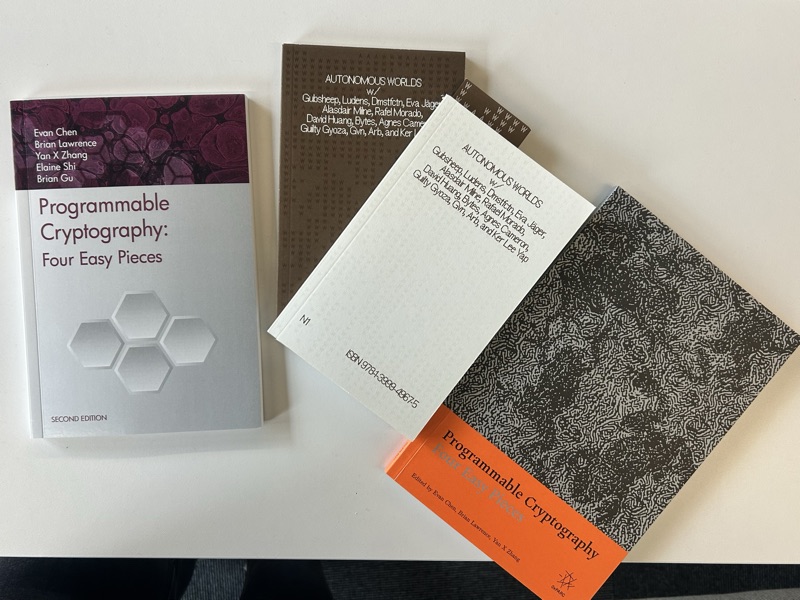
Four Easy Pieces
We write books! You can download Programmable Cryptography: Four Easy Pieces for free.
Read Four Easy Pieces →PC101 Course
We teach classes! Our book also served as the primary reference text for Programmable Cryptography 101, a class from fall 2025.
Visiting Scholars
We host amazing researchers! Professor Elaine Shi spent the first half of 2025 with us as a visiting scholar. While visiting, she and her collaborators published new research.
Read paper →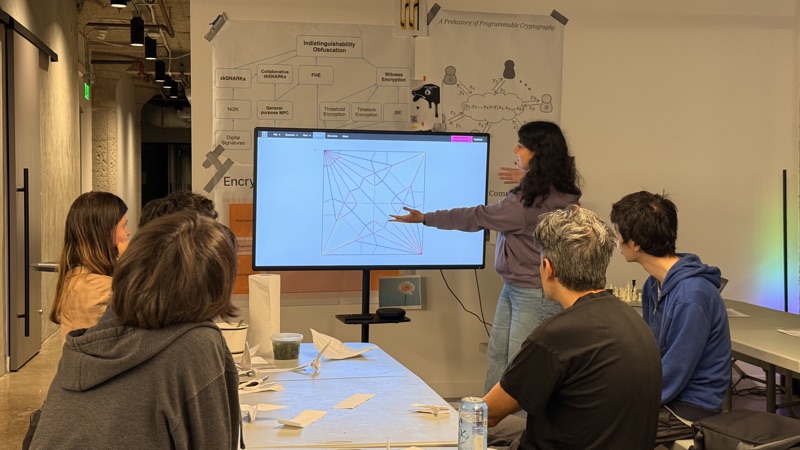
Summer Notes
We take notes! 0xPARC Summer 2025 Notes document our research explorations.
View Summer Notes →Puzzles and Connections
I have a secret list of positive integers: (v1, v2, ..., vn)
You can't see my list, but you can ask me dot product questions. Give me any list of numbers
(x1, x2, ..., xn) of the same length, and I'll tell you:
Figure out my secret list using as few questions as possible.
Suppose you have many black-box majority functions on three binary inputs. Is it possible to chain them to construct a majority function on 2025 binary inputs? (You can duplicate inputs and outputs of the black-box function for free.)
Part 2The CKKS fully homomorphic encryption scheme gives a way to encrypt vectors in ℂ32768 such that anyone can add encrypted vectors elementwise, multiply encrypted vectors elementwise, or "rotate" ciphertexts (z1, z2, ..., z65536) → (zi, zi+1, ..., zi-1) by any "offset" i.
Suppose that:
- encrypted addition takes 4 microseconds
- encrypted multiplication takes 5600 microseconds
- encrypted rotation takes 6100 microseconds
Find a fast arithmetic circuit that computes the Fourier transform on an encrypted vector, conditioned on the multiplicative depth of the circuit being at most three.
Are there any nontrivial solutions to the system of equations
a2 + b2 + c2 + d2 ≡ 0 (mod p)
a3 + b3 + c3 + d3 ≡ 0 (mod p)
for p = 2127 - 1?
Part 2The programming language circom allows users to prove that they have an assignment to a set of variables satisfying a system of quadratic constraints over linear combinations of variables
(lin. comb. of variables) × (lin. comb. of variables) ≡ (lin. comb. of variables) (mod p)
⋮
(lin. comb. of variables) × (lin. comb. of variables) ≡ (lin. comb. of variables) (mod p)
without revealing the complete assignment of variables. Here, p is a 254-bit prime number (*). Some of the variables are set to be public, and the rest are set to be private.
(*) p = 21888242871839275222246405745257275088548364400416034343698204186575808495617
